Maison de L'oro
Dutch 18th Century Soda Glass Goblet Vase – Baluster Stem with Nodus, c.1750–1775
Dutch 18th Century Soda Glass Goblet Vase – Baluster Stem with Nodus, c.1750–1775
Couldn't load pickup availability
This is not a vase. Well, technically it is — it holds flowers, it stands on a table, it has a mouth at the top — but calling it a vase is like calling the Rijksmuseum a building. Technically accurate. Entirely missing the point. This is a Dutch 18th-century mouth-blown soda glass goblet vase, made between 1750 and 1775, and it is one of the most quietly extraordinary objects you will ever own.
What you are looking at
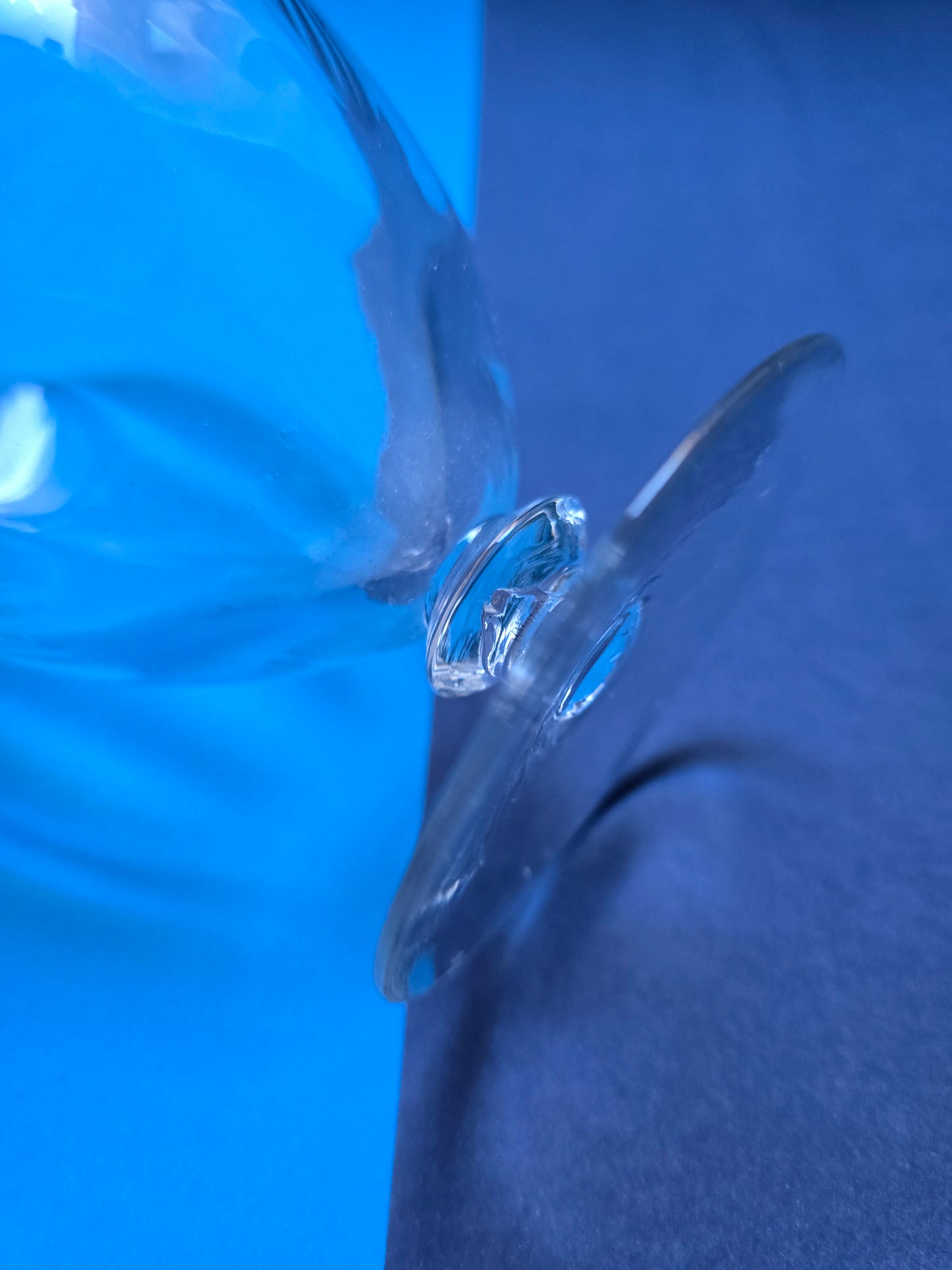
The form is a classic Dutch baluster: a generous ovoid bowl tapering to a narrow waist, then swelling again into the baluster stem with its characteristic nodus — that deliberate knop or knuckle in the stem that is the signature of 18th-century Dutch glassmaking. The foot is wide and stable, with a beautifully folded rim — the edge turned back on itself to add strength and a refined finish that was standard practice in the best Dutch glasshouses of the period. The whole thing is blown from soda glass, which gives it that characteristic slight greenish tint — not a flaw, but the natural colour of glass made with soda ash rather than lead, exactly as it was made in the Netherlands in the mid-18th century.
The marks of authenticity
This glass is a catalogue of everything that makes 18th-century hand-blown glass irreplaceable. There is a rough pontil mark on the base — the scar left where the glassblower's iron rod was broken away after forming. There are trapped air bubbles and fine glass threads at the junction of the foot. There is an internal stress crack — a hairline tension fracture within the glass itself, stable for 250 years, part of the biography of this object rather than a defect. And then there are the surface irregularities: subtle undulations, slight variations in wall thickness, gentle distortions in the glass that catch the light differently at every angle. No two square centimetres of this glass are identical. That is not a problem. That is the entire point. A machine cannot do this. A factory cannot do this. Only a glassblower, working alone, at the end of a blowpipe, in a Dutch glasshouse in the 1750s, could produce something this particular.
The glass walls are thin — genuinely thin, in the way that only mouth-blown glass can be — and the whole piece weighs just 263 grams despite standing 19 cm tall.
Height: 19 cm
Diameter: 11 cm
Weight: 263 grams
Material: Soda glass, mouth-blown
Colour: Clear with natural greenish tint
Origin: Netherlands
Year: circa 1750–1775
Features: Baluster stem with nodus, folded foot rim, rough pontil mark, trapped air bubbles, glass threads at foot junction, surface irregularities throughout
Condition: Very good — internal stress crack (stable, not a chip or break), no chips or external cracks
Display it in a spot with gentle, even light — every irregularity, every bubble, every thread of glass will glow beautifully. The answer is: rather magnificent.
WARNING: This glass is thin. Genuinely, historically, 18th-century thin. And precisely because it is so thin, it must never be placed in direct sunlight or near a heat source. Thin antique glass is highly sensitive to sudden temperature changes — the difference between a warm sunny windowsill and a cool draught is enough to cause it to crack. It has survived 275 years by being kept away from extremes, and that is exactly how it should continue to be treated. Display it in a spot with stable, even temperature and indirect light. Maison de L'oro considers this not a limitation, but a reminder that some things deserve to be looked after properly. This is one of them.
Share